
Thursday, September 24, 2026
Browse by Genre
Industrial Music / Industrial Metal / Aggro Industrial / Electro Metal
Industrial Noise / Power Noise / Harsh Noise
Synth Pop / Electro Pop / Synth-Electronica
Techno / Trance / Goa / Drum'n'Bass / Jungle / Tribal / Trip-Hop
Ambient / Electronica / Ethereal / Dub / Soundscapes / Abstract
Experimental / Avantgarde / Weird & Wired / Glitch / Noise / Field Recording
Dark / Gothic / Wave / New Wave / Dark Wave / Industrial Gothic
New Music / Downtown / Avantgarde Jazz / New Classical / World
Search Reviews
Music Reviews
Mariam Wallentin & Vestnorsk Jazzensemble: Spring Flood
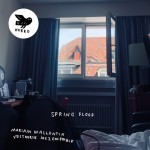
Artist: Mariam Wallentin & Vestnorsk Jazzensemble (@)
Title: Spring Flood
Format: LP
Label: Hubro (@)
Rated:

Title: Spring Flood
Format: LP
Label: Hubro (@)
Rated:
There is a particular danger in making an album about spring. Flowers, rivers, awakening bodies, longing, pale light, new beginnings: human beings have been putting these things into poems and songs for so long that one half expects a daffodil to arrive with its own publishing contract. "Spring Flood", however, manages to approach this familiar territory without turning it into a scented candle. Its spring is not merely pretty. It is restless, physical, slightly unruly, and very much alive.
The album began with Mariam Wallentin’s stay in Basel in May 2023, where the Rhine became both background noise and a stimulus for writing. The resulting notes, later brought to Bergen, were not treated as finished compositions so much as material to be opened up. Two days of recording with Vestnorsk Jazzensemble transformed these fragments into something considerably less private: a collective music in which Wallentin’s voice is constantly being reframed by strings, harp, trumpet, saxophones, electric guitar, bass and two drummers. This is important, because "Spring Flood" does not sound like a singer accompanied by a large jazz ensemble. It sounds like a singer entering a room where several different kinds of weather are already taking place.
Wallentin has spent much of her career refusing the polite border between experimental music, improvisation, jazz, soul and alternative song. Her work with Wildbirds & Peacedrums and Fire! Orchestra, alongside her Mariam The Believer project, has given her plenty of experience in treating the voice as something more flexible than a device for delivering melodies. Here she often sings as though language were another instrumental material, something capable of leaning into the arrangements, disappearing inside them or suddenly acquiring enormous physical presence. The ensemble, meanwhile, is not content to provide atmospheric decoration. Its strings can scratch and hover, the harp can glitter without becoming angelic, the horns can introduce colour or pressure, while the two-drum setup gives the music a curious elasticity: sometimes it moves like water, sometimes like a body that has just remembered it possesses muscles.
“Blanket Dance” establishes much of this vocabulary without immediately explaining it. The piece feels intimate and unstable in equal measure, its textures continually negotiating between delicacy and weight. “Basel” makes the geographical origin of the material less important than the sensation of being temporarily displaced. There is something wonderfully un-touristic about it. This is not music about visiting a beautiful European city and having thoughts beside a river; it is about what happens when a familiar inner life is forced to accommodate unfamiliar surroundings. The Rhine becomes less a subject than a pressure exerted on the music, a continuous movement against which Wallentin’s voice can measure itself.
“Red” is more overtly physical, its pulse suggesting the moment when contemplation starts becoming inconveniently corporeal. Spring here is not the gentle rebirth of greeting-card mythology but an increase in circulation, temperature and appetite. The colour is almost audible in the way the ensemble gathers intensity, with percussion and winds pushing the piece forward while the voice retains a certain vulnerability. “No Now”, by contrast, is barely long enough to settle into ordinary song form, functioning almost like a thought that interrupts itself. The album is particularly good at these changes of scale. A two-minute piece can carry as much psychological weight as a seven-minute one because Wallentin does not seem interested in filling time merely because the album has been given a running order.
“Love is Fire”, originally associated with Wildbirds & Peacedrums, introduces another useful complication. Returning to earlier material within a new collective setting could easily have become nostalgic, but here the song seems less like a look backwards than an opportunity to test what survives when the surrounding language changes. The familiar is made strange without being destroyed. That tension runs through the whole record: Basel and Bergen, private notes and public performance, composition and improvisation, tenderness and agitation, the individual voice and a group capable of swallowing it whole and then giving it back transformed.
What makes Vestnorsk Jazzensemble particularly well suited to this material is its very nature as a project-based formation rather than a permanently fixed band. The personnel can change according to the composer and the project, which means that the ensemble is less an established sound than a musical organism repeatedly assembled for particular circumstances. Kjetil Møster’s presence is especially telling, given his long involvement with Norwegian experimental jazz and his ability to inhabit both composed and improvisational environments without treating them as opposing camps. Here, nobody seems excessively interested in demonstrating how adventurous they are. The musicians listen, react, interrupt, reinforce and occasionally get out of the way. This sounds simple. It is not. Musicians are notoriously bad at leaving interesting space alone.
The final three pieces sharpen the album’s underlying idea of movement. “Wide” expands the palette without simply making everything louder, while “Now” reduces the music almost to a momentary intake of breath. Then the title track arrives for less than two minutes, and its brevity is exactly right. Rather than providing a grand finale, "Spring Flood" ends as though the phenomenon itself has passed through the room and is already continuing somewhere else. The river does not care about your preferred album structure.
That may ultimately be the record’s most convincing quality. Wallentin starts from highly personal material, but the musicians prevent it from remaining enclosed within autobiography. Feelings become textures, memories become rhythmic impulses, colours become arranging principles, and landscape becomes a set of relationships between sounds. The album is sensual without being decorative, poetic without becoming precious, and improvisational without confusing spontaneity with randomness.
"Spring Flood" understands that renewal is rarely as tidy as we would like it to be. Things thaw, swell, collide, become excessive, become beautiful, become inconvenient. Something buried starts moving again, and suddenly everybody has to deal with it. That is a rather more convincing definition of spring than the usual collection of pastel flowers.
The album began with Mariam Wallentin’s stay in Basel in May 2023, where the Rhine became both background noise and a stimulus for writing. The resulting notes, later brought to Bergen, were not treated as finished compositions so much as material to be opened up. Two days of recording with Vestnorsk Jazzensemble transformed these fragments into something considerably less private: a collective music in which Wallentin’s voice is constantly being reframed by strings, harp, trumpet, saxophones, electric guitar, bass and two drummers. This is important, because "Spring Flood" does not sound like a singer accompanied by a large jazz ensemble. It sounds like a singer entering a room where several different kinds of weather are already taking place.
Wallentin has spent much of her career refusing the polite border between experimental music, improvisation, jazz, soul and alternative song. Her work with Wildbirds & Peacedrums and Fire! Orchestra, alongside her Mariam The Believer project, has given her plenty of experience in treating the voice as something more flexible than a device for delivering melodies. Here she often sings as though language were another instrumental material, something capable of leaning into the arrangements, disappearing inside them or suddenly acquiring enormous physical presence. The ensemble, meanwhile, is not content to provide atmospheric decoration. Its strings can scratch and hover, the harp can glitter without becoming angelic, the horns can introduce colour or pressure, while the two-drum setup gives the music a curious elasticity: sometimes it moves like water, sometimes like a body that has just remembered it possesses muscles.
“Blanket Dance” establishes much of this vocabulary without immediately explaining it. The piece feels intimate and unstable in equal measure, its textures continually negotiating between delicacy and weight. “Basel” makes the geographical origin of the material less important than the sensation of being temporarily displaced. There is something wonderfully un-touristic about it. This is not music about visiting a beautiful European city and having thoughts beside a river; it is about what happens when a familiar inner life is forced to accommodate unfamiliar surroundings. The Rhine becomes less a subject than a pressure exerted on the music, a continuous movement against which Wallentin’s voice can measure itself.
“Red” is more overtly physical, its pulse suggesting the moment when contemplation starts becoming inconveniently corporeal. Spring here is not the gentle rebirth of greeting-card mythology but an increase in circulation, temperature and appetite. The colour is almost audible in the way the ensemble gathers intensity, with percussion and winds pushing the piece forward while the voice retains a certain vulnerability. “No Now”, by contrast, is barely long enough to settle into ordinary song form, functioning almost like a thought that interrupts itself. The album is particularly good at these changes of scale. A two-minute piece can carry as much psychological weight as a seven-minute one because Wallentin does not seem interested in filling time merely because the album has been given a running order.
“Love is Fire”, originally associated with Wildbirds & Peacedrums, introduces another useful complication. Returning to earlier material within a new collective setting could easily have become nostalgic, but here the song seems less like a look backwards than an opportunity to test what survives when the surrounding language changes. The familiar is made strange without being destroyed. That tension runs through the whole record: Basel and Bergen, private notes and public performance, composition and improvisation, tenderness and agitation, the individual voice and a group capable of swallowing it whole and then giving it back transformed.
What makes Vestnorsk Jazzensemble particularly well suited to this material is its very nature as a project-based formation rather than a permanently fixed band. The personnel can change according to the composer and the project, which means that the ensemble is less an established sound than a musical organism repeatedly assembled for particular circumstances. Kjetil Møster’s presence is especially telling, given his long involvement with Norwegian experimental jazz and his ability to inhabit both composed and improvisational environments without treating them as opposing camps. Here, nobody seems excessively interested in demonstrating how adventurous they are. The musicians listen, react, interrupt, reinforce and occasionally get out of the way. This sounds simple. It is not. Musicians are notoriously bad at leaving interesting space alone.
The final three pieces sharpen the album’s underlying idea of movement. “Wide” expands the palette without simply making everything louder, while “Now” reduces the music almost to a momentary intake of breath. Then the title track arrives for less than two minutes, and its brevity is exactly right. Rather than providing a grand finale, "Spring Flood" ends as though the phenomenon itself has passed through the room and is already continuing somewhere else. The river does not care about your preferred album structure.
That may ultimately be the record’s most convincing quality. Wallentin starts from highly personal material, but the musicians prevent it from remaining enclosed within autobiography. Feelings become textures, memories become rhythmic impulses, colours become arranging principles, and landscape becomes a set of relationships between sounds. The album is sensual without being decorative, poetic without becoming precious, and improvisational without confusing spontaneity with randomness.
"Spring Flood" understands that renewal is rarely as tidy as we would like it to be. Things thaw, swell, collide, become excessive, become beautiful, become inconvenient. Something buried starts moving again, and suddenly everybody has to deal with it. That is a rather more convincing definition of spring than the usual collection of pastel flowers.
tsx x sue tompkins: recur⁷

Artist: tsx x sue tompkins
Title: recur⁷
Format: Download Only (MP3 + Lossless)
Label: generate and test
Rated:

Title: recur⁷
Format: Download Only (MP3 + Lossless)
Label: generate and test
Rated:
Some records take five years to make because their authors are perfectionists. Others take five years because life has a habit of throwing furniture down the stairs whenever you are trying to finish something. "recur7" appears to belong, quite happily, to both categories. Conceived between 2019 and 2024 and only cosmetically altered since, this five-track, fifteen-minute collaboration between tsx and Sue Tompkins is a remarkably compact object carrying an unusually large amount of temporal baggage. Its central idea is simple enough: to return to something similar, but never quite the same. Its execution is considerably less polite.
tsx is the beat-oriented persona of Oswald Berthold, whose work with farmersmanual has been investigating digital systems, algorithmic processes and the peculiar aesthetics of computers since the 1990s. The tsx project began in 2017 with "recur", initially developed around the very contemporary idea of making beats while travelling through urban space with a mobile phone. That constraint has remained fundamental even as desktop tools have entered the process. There is something fitting about an artistic method that started with spare moments on public transport eventually producing a piece of music that itself seems permanently in transit.
Sue Tompkins brings a completely different kind of history. Trained as a painter at Glasgow School of Art, she became widely known through Life Without Buildings before developing a substantial visual and performance practice centred on language, repetition, rhythm and the physical possibilities of speech. Her voice has always occupied an interesting zone between speaking and singing, between sentence and gesture. On "recur7", that linguistic personality is not simply sampled. It is subjected to a little computational bureaucracy, chopped into fragments, sorted according to perceived sonic similarity and then rearranged by software. The result is less “vocals over electronic music” than a conversation between a human mouth and a machine that has become irritatingly confident about syntax.
"Mute their knee" establishes the peculiar rules immediately. Its rhythmic background was conceived from the simple physical sensation of rain hitting a skylight, but what emerges is anything but pastoral. Tiny percussive events multiply into a jittering mesh, with the familiar four-square expectations of digital rhythm repeatedly nudged sideways. The track feels as though someone has asked a metronome to describe weather and then refused to correct the answer.
The important distinction is that tsx's glitchiness is not primarily about damage. It is about "reclassification". Sounds are taken out of their original context, processed, sliced, reordered and made to function according to new relationships. The machinery is not hiding behind the music. It is part of the composition's visible logic. That makes "recur7" particularly interesting in the context of Berthold's much longer engagement with computer-based aesthetics. Farmersmanual has spent decades treating digital systems not merely as tools for making music but as environments in which musical decisions can be generated, distorted and reconsidered. Here that approach has been reduced to miniature scale.
Then Sue's voice enters and everything becomes more slippery. "Easily live for" breaks her recordings into minute sonic particles and allows an algorithmic process to determine their new positions. Meaning begins to dissolve not because the words are deliberately obscured, but because the temporal structure that normally allows language to make sense has been dismantled. A phrase is no longer necessarily a phrase. A syllable can become percussion, texture or an almost melodic object. The voice remains recognisably human while the sentence ceases to belong entirely to the human world.
That tension is one of the album's strongest qualities. Tompkins has spent much of her career exploring what language can do when it is treated as physical material rather than simply as a vehicle for information. Her performances, visual work and musical collaborations repeatedly make repetition and rhythm central to the experience of words. "recur7" takes the next step and asks what happens when an algorithm is allowed to participate in that repetition. The machine does not understand the words in the way a listener does. It understands relationships between sounds. Consequently, semantic meaning becomes collateral damage, while phonetic identity survives.
"The pleasure of completed action" is perhaps the funniest title on an album that spends considerable effort refusing to behave as though anything is ever truly completed. Its rain-derived rhythmic material has a nervous, almost granular quality, while the synthetic layers generated through a pulsar synthesis system are controlled by the movement of a pet robot. This is exactly the sort of sentence that would have sounded like an elaborate joke about electronic music thirty years ago. Here it is simply part of the production method. The robot does not need to understand music. It only needs to move, and suddenly its movements become parameters in an electronic composition. Humanity has finally found a use for the domestic pet it invented in order to avoid having a real one.
The middle of the record, "dream city times half", pushes further into the fractured relationship between voice and rhythm. The title itself suggests an operation rather than a statement: something divided, transformed, reduced. Tompkins's vocal fragments are repeatedly interrupted by the system that processes them, producing a form of speech that feels both intimate and inaccessible. You can sense that there was once a complete utterance behind the fragments, but the music has no obligation to reconstruct it for you.
This is where the album's five-year history becomes audible in a curious way. "recur7" is not obsessed with the past in the nostalgic sense. It is interested in what happens when material is revisited. The tracks began years earlier, were iterated over time, circulated in provisional forms and eventually arrived at something that was almost unchanged from an earlier private version. The delay is therefore not merely a production anecdote. It is structurally consistent with the project's central idea: returning to an existing state and finding that the return itself has changed it.
The final "just so, so just" makes that principle particularly clear. The words are still there, or at least their physical ghosts are. They are cut, rearranged, stretched into rhythmic events and surrounded by synthetic textures whose behaviour has little interest in conventional accompaniment. The track seems to ask whether meaning can survive after language has been deprived of its original chronology. The answer is neither yes nor no. Meaning becomes something more unstable: an impression assembled by the listener from pieces that were never put there in that order.
There is an unexpected warmth beneath all this technical cleverness. The machines may perform the rearranging, but the source material remains intensely personal and bodily. A voice recorded casually on a phone carries the imperfections of circumstance. The resulting fragments retain breath, emphasis and grain even after their semantic function has been scrambled. The technology therefore does not sterilise Tompkins's presence. If anything, it makes the human traces more conspicuous by surrounding them with processes that cannot quite reproduce them.
This is also why "recur7" avoids the familiar trap of algorithmic experimental music becoming a demonstration of software capabilities. There is plenty of bespoke technology here, but the technology has a job. Similarity models, beat-aware rearrangement, pulsar synthesis and robotic control are all subordinate to the larger question of recurrence. The interesting thing is not that a machine can chop up a voice. That became obvious some time ago. The interesting thing is what happens to a voice when its fragments are given a new social life inside a rhythm.
There is, finally, a rather lovely contradiction at the centre of the record. Its title promises repetition, while its methods depend upon difference. To recur is not to repeat. It is to approach the same neighbourhood from another street, carrying whatever happened since the last visit. The "recur" series has accumulated its own history since 2017, and this collaboration with Tompkins has become one of its recurring meeting points. Yet "recur7" does not sound like a museum piece from an ongoing series. It sounds like the series has developed another nervous system.
Fifteen minutes is enough. Anything longer might allow the algorithm to develop opinions.
As it stands, "recur7" is a miniature study in digital memory, where beats, words, accidents and machines continually rearrange one another. It is playful without being cute, technically elaborate without becoming a technology brochure, and fragmented without confusing fragmentation with depth. Most importantly, it understands that repetition is never neutral. Every return carries evidence of what happened in the meantime.
Even when the return takes five years.
tsx is the beat-oriented persona of Oswald Berthold, whose work with farmersmanual has been investigating digital systems, algorithmic processes and the peculiar aesthetics of computers since the 1990s. The tsx project began in 2017 with "recur", initially developed around the very contemporary idea of making beats while travelling through urban space with a mobile phone. That constraint has remained fundamental even as desktop tools have entered the process. There is something fitting about an artistic method that started with spare moments on public transport eventually producing a piece of music that itself seems permanently in transit.
Sue Tompkins brings a completely different kind of history. Trained as a painter at Glasgow School of Art, she became widely known through Life Without Buildings before developing a substantial visual and performance practice centred on language, repetition, rhythm and the physical possibilities of speech. Her voice has always occupied an interesting zone between speaking and singing, between sentence and gesture. On "recur7", that linguistic personality is not simply sampled. It is subjected to a little computational bureaucracy, chopped into fragments, sorted according to perceived sonic similarity and then rearranged by software. The result is less “vocals over electronic music” than a conversation between a human mouth and a machine that has become irritatingly confident about syntax.
"Mute their knee" establishes the peculiar rules immediately. Its rhythmic background was conceived from the simple physical sensation of rain hitting a skylight, but what emerges is anything but pastoral. Tiny percussive events multiply into a jittering mesh, with the familiar four-square expectations of digital rhythm repeatedly nudged sideways. The track feels as though someone has asked a metronome to describe weather and then refused to correct the answer.
The important distinction is that tsx's glitchiness is not primarily about damage. It is about "reclassification". Sounds are taken out of their original context, processed, sliced, reordered and made to function according to new relationships. The machinery is not hiding behind the music. It is part of the composition's visible logic. That makes "recur7" particularly interesting in the context of Berthold's much longer engagement with computer-based aesthetics. Farmersmanual has spent decades treating digital systems not merely as tools for making music but as environments in which musical decisions can be generated, distorted and reconsidered. Here that approach has been reduced to miniature scale.
Then Sue's voice enters and everything becomes more slippery. "Easily live for" breaks her recordings into minute sonic particles and allows an algorithmic process to determine their new positions. Meaning begins to dissolve not because the words are deliberately obscured, but because the temporal structure that normally allows language to make sense has been dismantled. A phrase is no longer necessarily a phrase. A syllable can become percussion, texture or an almost melodic object. The voice remains recognisably human while the sentence ceases to belong entirely to the human world.
That tension is one of the album's strongest qualities. Tompkins has spent much of her career exploring what language can do when it is treated as physical material rather than simply as a vehicle for information. Her performances, visual work and musical collaborations repeatedly make repetition and rhythm central to the experience of words. "recur7" takes the next step and asks what happens when an algorithm is allowed to participate in that repetition. The machine does not understand the words in the way a listener does. It understands relationships between sounds. Consequently, semantic meaning becomes collateral damage, while phonetic identity survives.
"The pleasure of completed action" is perhaps the funniest title on an album that spends considerable effort refusing to behave as though anything is ever truly completed. Its rain-derived rhythmic material has a nervous, almost granular quality, while the synthetic layers generated through a pulsar synthesis system are controlled by the movement of a pet robot. This is exactly the sort of sentence that would have sounded like an elaborate joke about electronic music thirty years ago. Here it is simply part of the production method. The robot does not need to understand music. It only needs to move, and suddenly its movements become parameters in an electronic composition. Humanity has finally found a use for the domestic pet it invented in order to avoid having a real one.
The middle of the record, "dream city times half", pushes further into the fractured relationship between voice and rhythm. The title itself suggests an operation rather than a statement: something divided, transformed, reduced. Tompkins's vocal fragments are repeatedly interrupted by the system that processes them, producing a form of speech that feels both intimate and inaccessible. You can sense that there was once a complete utterance behind the fragments, but the music has no obligation to reconstruct it for you.
This is where the album's five-year history becomes audible in a curious way. "recur7" is not obsessed with the past in the nostalgic sense. It is interested in what happens when material is revisited. The tracks began years earlier, were iterated over time, circulated in provisional forms and eventually arrived at something that was almost unchanged from an earlier private version. The delay is therefore not merely a production anecdote. It is structurally consistent with the project's central idea: returning to an existing state and finding that the return itself has changed it.
The final "just so, so just" makes that principle particularly clear. The words are still there, or at least their physical ghosts are. They are cut, rearranged, stretched into rhythmic events and surrounded by synthetic textures whose behaviour has little interest in conventional accompaniment. The track seems to ask whether meaning can survive after language has been deprived of its original chronology. The answer is neither yes nor no. Meaning becomes something more unstable: an impression assembled by the listener from pieces that were never put there in that order.
There is an unexpected warmth beneath all this technical cleverness. The machines may perform the rearranging, but the source material remains intensely personal and bodily. A voice recorded casually on a phone carries the imperfections of circumstance. The resulting fragments retain breath, emphasis and grain even after their semantic function has been scrambled. The technology therefore does not sterilise Tompkins's presence. If anything, it makes the human traces more conspicuous by surrounding them with processes that cannot quite reproduce them.
This is also why "recur7" avoids the familiar trap of algorithmic experimental music becoming a demonstration of software capabilities. There is plenty of bespoke technology here, but the technology has a job. Similarity models, beat-aware rearrangement, pulsar synthesis and robotic control are all subordinate to the larger question of recurrence. The interesting thing is not that a machine can chop up a voice. That became obvious some time ago. The interesting thing is what happens to a voice when its fragments are given a new social life inside a rhythm.
There is, finally, a rather lovely contradiction at the centre of the record. Its title promises repetition, while its methods depend upon difference. To recur is not to repeat. It is to approach the same neighbourhood from another street, carrying whatever happened since the last visit. The "recur" series has accumulated its own history since 2017, and this collaboration with Tompkins has become one of its recurring meeting points. Yet "recur7" does not sound like a museum piece from an ongoing series. It sounds like the series has developed another nervous system.
Fifteen minutes is enough. Anything longer might allow the algorithm to develop opinions.
As it stands, "recur7" is a miniature study in digital memory, where beats, words, accidents and machines continually rearrange one another. It is playful without being cute, technically elaborate without becoming a technology brochure, and fragmented without confusing fragmentation with depth. Most importantly, it understands that repetition is never neutral. Every return carries evidence of what happened in the meantime.
Even when the return takes five years.
Espen Berg Trio: Entropies

There is something faintly comic about naming a jazz album "Entropies" and then spending forty-four minutes demonstrating that everything is, in fact, under control. Espen Berg Trio are hardly interested in letting the furniture fly out of the windows, but neither are they content with keeping every object politely in its assigned place. "Entropies" is music fascinated by the point at which structure begins to loosen, when a pattern remains recognisable while its internal logic quietly starts misbehaving. The result is a piano-trio record that sounds meticulously constructed and surprisingly alive to accidents.
Espen Berg, Bárður Reinert Poulsen and Simon Albertsen have been playing together since 2014, long enough for their communication to have moved beyond the obvious mechanics of piano, bass and drums. Berg has meanwhile developed a substantial career as both pianist and composer, including solo work and collaborations across the Norwegian jazz scene, while the trio has toured extensively in Europe and Asia. Their fifth album arrives after nearly three years of development, and that long gestation is audible in the precision of the writing. Yet "Entropies" never gives the impression of having been ironed flat before being released. The compositions leave room for spontaneous decisions, polymetric structures and changes of density that make the music feel as though it is constantly negotiating with itself.
The opening "Equilibrium Suite" immediately plays a small joke on its own title. Part One establishes a relatively calm field, with Berg's piano moving through supple figures while Poulsen and Albertsen provide a rhythmic environment that is less accompaniment than active weather. The balance is temporary. Part Two takes the material somewhere more animated, allowing patterns to recur in altered forms and rhythmic relationships to become increasingly slippery. The important thing is that the trio does not dramatise this instability. There is no musical siren announcing that Disorder Has Arrived. The musicians simply alter the conditions and carry on.
That ability to make complexity feel conversational is one of Berg's strongest qualities. His piano playing can be extraordinarily busy without becoming cluttered, partly because the left and right hands often seem to inhabit different rhythmic climates. Poulsen does not merely reinforce the lower register, either. His bass frequently acts as a counterweight or alternative route through the composition, while Albertsen has a particularly sharp sense of when not to fill a space. The trio's sophistication lies less in how many things they can play simultaneously than in how precisely they can decide which thing should happen next.
"Rue Saint-Michel" offers a different kind of concentration. Berg wrote several pieces for the album during a 2024 residency in Vence, southern France, and this one took its title from a street there. The music is comparatively open and lyrical, with Flavia Huarachi's flute and Joakim Munkner's cello adding colours that soften the trio's core sound without obscuring it. There is a sense of lightness here, but not relaxation in the conventional smooth-jazz sense. The rhythm section keeps the piece slightly off-centre, as though the melody has been given a beautiful view but is not entirely certain which direction the road goes.
"The Parade" is where the trio's rhythmic personality becomes particularly obvious. Berg's melodic ideas remain sharply defined while the bass and drums continually rearrange their surroundings. Poulsen's playing gives the piece a physical propulsion, and Albertsen seems to regard the beat as something that can be approached from several angles rather than a fixed piece of municipal infrastructure. The music is energetic without simply becoming fast, which is an important distinction. Speed is easy. Momentum is harder.
Then comes "Nap of the Earth", one of the album's most intriguing little pieces precisely because it refuses to behave like a miniature version of the others. Its repeated piano patterns establish a hypnotic framework, while guitar and vocals from Nils Olav Johansen add an unfamiliar texture. The result hints at minimalist repetition without settling comfortably inside it. It is almost a sketch of another album hiding inside this one, a brief suggestion that the trio could take its fascination with repetition, asymmetry and gradual change considerably further.
"XXI" and "Eidsvals" return the focus to the trio itself. Here the balance between composition and interaction becomes increasingly difficult to separate. Berg's themes are strong enough to survive substantial rhythmic manipulation, but they do not dictate every movement. "Eidsvals" in particular gives Poulsen space to step forward, showing why the bass is so important to the album's sense of motion. Albertsen remains comparatively economical, yet his interventions repeatedly change the apparent weight of the music. Three players can produce an enormous amount of information without sounding as though they are competing for the last available microphone.
And then there is "Russians", the inevitable moment when someone decides that a Sting song belongs on a contemporary Norwegian piano-trio album. On paper, it is exactly the sort of idea that could collapse under the weight of its own cleverness. In practice, Berg's arrangement treats the melody as something malleable rather than sacred. The song is recognisable, but its familiar emotional architecture is gradually opened up. The trio gives it more space, lets the harmony breathe differently, and allows the instrumental interplay to become the real subject. The presence of Munkner's cello adds another layer to an arrangement that manages to avoid both reverence and parody.
The closing "Transients" is brief and restless, and its title feels appropriate without needing to become a thesis statement. Fragments appear, disappear and reconfigure themselves with a slightly nervous energy. After the album's more expansive compositions, this compression is effective. It leaves the impression of a system still moving after the formal conclusion has already been reached. The record does not end because all the questions have been resolved. It ends because the musicians have decided that forty-four minutes is probably enough time to make their point before entropy starts sending them the bill.
The album's influences are broad enough to be potentially dangerous: Berg has cited figures such as Craig Taborn, Nik BÄrtsch, Keith Jarrett and Brad Mehldau, musicians whose approaches to rhythm, harmony and improvisation could easily produce an album sounding like an academic conference with cymbals. "Entropies" avoids that trap because those influences are absorbed into a trio identity that has developed over more than a decade. The music does not resemble a collection of references. It sounds like musicians who have listened widely and then gone back to arguing among themselves.
What makes the album particularly convincing is that its central opposition, order versus dissolution, never becomes simplistic. The music is not divided into “composed” passages and “free” passages, as though two teams had been assigned opposite halves of the pitch. Instead, composition creates the conditions in which freedom becomes meaningful. A melody can be memorable precisely because the rhythm destabilises it. A repeated figure can become expressive because it refuses to return identically. Silence can carry weight because the musicians have established enough density for its absence to register.
There is a certain Scandinavian stereotype that contemporary Norwegian jazz must either involve melancholy, weather or a man staring at a fjord while contemplating the mortality of spruce trees. "Entropies" is considerably less solemn. Its technical sophistication is matched by a sense of play, and its most complicated structures are often the places where the trio sounds most amused by its own possibilities. That playfulness is not decorative. It is what prevents the album's conceptual ambitions from becoming heavy-handed.
Ultimately, "Entropies" is not really about disorder. It is about the elasticity of order: how far a pattern can be bent before it becomes something new, how much freedom a composition can accommodate before its identity disappears, and how three musicians can remain unmistakably themselves while continually changing the circumstances in which they operate. Berg writes the maps, Poulsen and Albertsen keep moving the landmarks, and the listener is left to work out whether the resulting landscape is carefully planned or merely very good at pretending to be accidental.
Probably both. Which, for a piano trio, is a rather productive state of confusion.
Espen Berg, Bárður Reinert Poulsen and Simon Albertsen have been playing together since 2014, long enough for their communication to have moved beyond the obvious mechanics of piano, bass and drums. Berg has meanwhile developed a substantial career as both pianist and composer, including solo work and collaborations across the Norwegian jazz scene, while the trio has toured extensively in Europe and Asia. Their fifth album arrives after nearly three years of development, and that long gestation is audible in the precision of the writing. Yet "Entropies" never gives the impression of having been ironed flat before being released. The compositions leave room for spontaneous decisions, polymetric structures and changes of density that make the music feel as though it is constantly negotiating with itself.
The opening "Equilibrium Suite" immediately plays a small joke on its own title. Part One establishes a relatively calm field, with Berg's piano moving through supple figures while Poulsen and Albertsen provide a rhythmic environment that is less accompaniment than active weather. The balance is temporary. Part Two takes the material somewhere more animated, allowing patterns to recur in altered forms and rhythmic relationships to become increasingly slippery. The important thing is that the trio does not dramatise this instability. There is no musical siren announcing that Disorder Has Arrived. The musicians simply alter the conditions and carry on.
That ability to make complexity feel conversational is one of Berg's strongest qualities. His piano playing can be extraordinarily busy without becoming cluttered, partly because the left and right hands often seem to inhabit different rhythmic climates. Poulsen does not merely reinforce the lower register, either. His bass frequently acts as a counterweight or alternative route through the composition, while Albertsen has a particularly sharp sense of when not to fill a space. The trio's sophistication lies less in how many things they can play simultaneously than in how precisely they can decide which thing should happen next.
"Rue Saint-Michel" offers a different kind of concentration. Berg wrote several pieces for the album during a 2024 residency in Vence, southern France, and this one took its title from a street there. The music is comparatively open and lyrical, with Flavia Huarachi's flute and Joakim Munkner's cello adding colours that soften the trio's core sound without obscuring it. There is a sense of lightness here, but not relaxation in the conventional smooth-jazz sense. The rhythm section keeps the piece slightly off-centre, as though the melody has been given a beautiful view but is not entirely certain which direction the road goes.
"The Parade" is where the trio's rhythmic personality becomes particularly obvious. Berg's melodic ideas remain sharply defined while the bass and drums continually rearrange their surroundings. Poulsen's playing gives the piece a physical propulsion, and Albertsen seems to regard the beat as something that can be approached from several angles rather than a fixed piece of municipal infrastructure. The music is energetic without simply becoming fast, which is an important distinction. Speed is easy. Momentum is harder.
Then comes "Nap of the Earth", one of the album's most intriguing little pieces precisely because it refuses to behave like a miniature version of the others. Its repeated piano patterns establish a hypnotic framework, while guitar and vocals from Nils Olav Johansen add an unfamiliar texture. The result hints at minimalist repetition without settling comfortably inside it. It is almost a sketch of another album hiding inside this one, a brief suggestion that the trio could take its fascination with repetition, asymmetry and gradual change considerably further.
"XXI" and "Eidsvals" return the focus to the trio itself. Here the balance between composition and interaction becomes increasingly difficult to separate. Berg's themes are strong enough to survive substantial rhythmic manipulation, but they do not dictate every movement. "Eidsvals" in particular gives Poulsen space to step forward, showing why the bass is so important to the album's sense of motion. Albertsen remains comparatively economical, yet his interventions repeatedly change the apparent weight of the music. Three players can produce an enormous amount of information without sounding as though they are competing for the last available microphone.
And then there is "Russians", the inevitable moment when someone decides that a Sting song belongs on a contemporary Norwegian piano-trio album. On paper, it is exactly the sort of idea that could collapse under the weight of its own cleverness. In practice, Berg's arrangement treats the melody as something malleable rather than sacred. The song is recognisable, but its familiar emotional architecture is gradually opened up. The trio gives it more space, lets the harmony breathe differently, and allows the instrumental interplay to become the real subject. The presence of Munkner's cello adds another layer to an arrangement that manages to avoid both reverence and parody.
The closing "Transients" is brief and restless, and its title feels appropriate without needing to become a thesis statement. Fragments appear, disappear and reconfigure themselves with a slightly nervous energy. After the album's more expansive compositions, this compression is effective. It leaves the impression of a system still moving after the formal conclusion has already been reached. The record does not end because all the questions have been resolved. It ends because the musicians have decided that forty-four minutes is probably enough time to make their point before entropy starts sending them the bill.
The album's influences are broad enough to be potentially dangerous: Berg has cited figures such as Craig Taborn, Nik BÄrtsch, Keith Jarrett and Brad Mehldau, musicians whose approaches to rhythm, harmony and improvisation could easily produce an album sounding like an academic conference with cymbals. "Entropies" avoids that trap because those influences are absorbed into a trio identity that has developed over more than a decade. The music does not resemble a collection of references. It sounds like musicians who have listened widely and then gone back to arguing among themselves.
What makes the album particularly convincing is that its central opposition, order versus dissolution, never becomes simplistic. The music is not divided into “composed” passages and “free” passages, as though two teams had been assigned opposite halves of the pitch. Instead, composition creates the conditions in which freedom becomes meaningful. A melody can be memorable precisely because the rhythm destabilises it. A repeated figure can become expressive because it refuses to return identically. Silence can carry weight because the musicians have established enough density for its absence to register.
There is a certain Scandinavian stereotype that contemporary Norwegian jazz must either involve melancholy, weather or a man staring at a fjord while contemplating the mortality of spruce trees. "Entropies" is considerably less solemn. Its technical sophistication is matched by a sense of play, and its most complicated structures are often the places where the trio sounds most amused by its own possibilities. That playfulness is not decorative. It is what prevents the album's conceptual ambitions from becoming heavy-handed.
Ultimately, "Entropies" is not really about disorder. It is about the elasticity of order: how far a pattern can be bent before it becomes something new, how much freedom a composition can accommodate before its identity disappears, and how three musicians can remain unmistakably themselves while continually changing the circumstances in which they operate. Berg writes the maps, Poulsen and Albertsen keep moving the landmarks, and the listener is left to work out whether the resulting landscape is carefully planned or merely very good at pretending to be accidental.
Probably both. Which, for a piano trio, is a rather productive state of confusion.
Leo Svensson Sander: La belle année (Original Motion Picture Soundtrack)

Artist: Leo Svensson Sander (@)
Title: La belle année (Original Motion Picture Soundtrack)
Format: Download Only (MP3 + Lossless)
Label: Thanatosis Produktion (@)
Rated:
Title: La belle année (Original Motion Picture Soundtrack)
Format: Download Only (MP3 + Lossless)
Label: Thanatosis Produktion (@)
Rated:
Film music has an awkward job. It is supposed to make us feel something without announcing that it is making us feel something, support an image without stealing its clothes, and disappear into the film while somehow remaining memorable afterwards. Leo Svensson Sander’s "La belle année" solves the problem by doing something much simpler: it behaves like memory. It arrives in fragments, repeats itself with slight alterations, changes scale, disappears before it has quite finished explaining itself, and occasionally returns wearing a different face.
The soundtrack was written for Angelica Ruffier’s hybrid documentary "La belle année", a film born from the aftermath of her estranged father’s death and the rediscovery of an intense teenage fascination with her history teacher. The film premiered in the Tiger Competition at Rotterdam in 2026, where it received the Special Jury Award, and subsequently travelled through the festival circuit. Its structure moves between present-day observation, diary material and more openly constructed or dreamlike sequences, making the distinction between remembered experience and recreated experience deliberately unstable.
Svensson Sander responds with remarkable economy. Rather than covering the screen in an orchestral blanket, he largely works with solo instruments: cello, piano, clarinet, synthesizer, bass recorder and voice. The decision is crucial. These sounds retain the physical individuality of the people producing them. A cello does not merely signify sadness, a piano does not automatically mean memory, and a clarinet has thankfully not been sentenced to spend its entire existence representing European melancholy. Instead, the instruments become almost tactile extensions of the characters and their surroundings.
The composer is particularly well suited to this kind of ambiguity. Stockholm-based, born in Skåne in 1975, Svensson Sander began within classical music before moving through Scandinavian folk, pop, improvisation and experimental music. He was a member of The Tiny and has worked with artists and ensembles ranging from Time Is a Blind Guide and Fire! Orchestra to Goran Kajfeš and Lena Willemark, while his parallel career has increasingly involved composition for film, theatre and dance. He also studied film-music composition at Stockholm’s Royal College of Music. That mixture of disciplines explains why these pieces rarely sound as though they belong exclusively to the concert hall or the cinema. They occupy the rather more interesting territory between the two.
The opening "Spegel" is a perfect example. Alex Zethson’s piano provides the entire piece with an almost miniature sense of architecture, while its mirrored melodic behaviour reflects one of the film's central ideas: identity as something produced through fascination with another person. The musical material moves in opposite directions, creating a tiny mechanism of attraction and resistance. It lasts less than two minutes, but its brevity is part of the point. A memory does not generally wait around until the composer has completed a satisfactory development section.
"Efter" and "Sysslorna" bring Svensson Sander's cello into the more mundane side of the film's emotional landscape. The distinction matters. Ruffier’s story is not constructed solely from dramatic recollection; there are houses to empty, objects to move, practical tasks to complete after someone has died. Grief, in other words, has paperwork. Svensson Sander understands that mourning is often experienced through repetition and routine rather than permanent cinematic thunder. The cello therefore feels close to the body, sometimes conversational, sometimes almost like a voice that has decided not to use words.
Then "Rosen" expands the emotional vocabulary without abandoning its intimacy. Zethson's piano can suggest tenderness without becoming sugary, partly because Svensson Sander is interested in how a small motif changes rather than in manufacturing an obvious emotional payoff. Across the soundtrack, fragments are stretched, compressed, multiplied or displaced. Some return in altered forms, creating relationships that become clearer only retrospectively. This is an unusually intelligent approach to film scoring because it imitates the way memory actually behaves: it edits us without asking permission.
The night sequence begins to loosen that restraint. "In i natten", with synth and drums, changes the physical character of the album almost immediately. The music no longer seems attached to the practical world of rooms, boxes and household chores. It enters a less stable territory in which desire and imagination can interfere with chronology. "Dimman", featuring Per “Texas” Johansson on clarinet alongside Svensson Sander on bass recorder, makes that transition even stranger. The combination is fragile, slightly archaic and almost impossible to place historically. It sounds like two people trying to remember the same dream and discovering that their versions disagree.
Johansson's clarinet becomes particularly evocative in "Dag mot skymning" and "Farfar". There is an unusual amount of expressive information contained in the instrument's breath and attack, and Svensson Sander wisely does not over-orchestrate it. The clarinet can sound intimate one moment and oddly distant the next, which suits a film concerned with people who exist simultaneously as present individuals and remembered figures. It also reinforces the album's central movement from day toward night, from physical obligation toward imagination.
The soundtrack's most revealing trick is perhaps its refusal to distinguish neatly between the personal and the fictional. "Hon heter Sylvie", with cello and voice, turns the name itself into musical material. The history teacher who occupies the protagonist's teenage imagination is neither simply a remembered person nor simply a character in an old fantasy. She has become part of the machinery through which the protagonist understands herself. The score consequently does not need to tell us that memory can invent people. It demonstrates the process musically.
By the time "Vattenfall" arrives, piano and percussion create a slightly more kinetic surface, before "Vidare" returns to cello for the final minute. That last title, meaning “forward” or “onward,” could easily have produced a motivational-calendar ending. Fortunately, Svensson Sander has better taste. The piece does not triumphantly resolve the story. It simply continues. After death, desire, memory, adolescence and all the domestic debris left behind, continuation is perhaps the most honest conclusion available.
At only around twenty-seven minutes, "La belle année" is concise enough to feel almost like a suite of recollected photographs. Yet its brevity makes the relationships between the pieces more important, not less. Motifs behave like recurring thoughts; instrumentation marks changes in psychological temperature; the alternation between daytime practicality and nocturnal fantasy gives the sequence a subtle dramatic rhythm. Heard away from the film, the music retains enough ambiguity to create its own images. Heard in relation to the film, those images become more complicated rather than merely more obvious.
That is ultimately what makes this soundtrack successful as an independent release. It does not attempt to reproduce the film in audio form. Instead, it preserves its method: observation interrupted by imagination, the ordinary invaded by the remembered, the present continually negotiating with versions of the past. Svensson Sander's music understands that intimacy rarely requires a large gesture. Sometimes it needs only a cello, a few piano notes, a clarinet breathing slightly differently, and enough silence around them to let the memory become unreliable.
"La belle année" is therefore less a collection of cues than a small album about the peculiar mechanics of remembering. It knows that the past does not return intact, that desire edits history, and that even grief has to coexist with washing dishes and emptying rooms. The clever part is that none of this is presented as a grand philosophical revelation. It simply appears in twelve short pieces, quietly changing shape as they pass. Memory, like film music, apparently prefers to work while nobody is looking.
The soundtrack was written for Angelica Ruffier’s hybrid documentary "La belle année", a film born from the aftermath of her estranged father’s death and the rediscovery of an intense teenage fascination with her history teacher. The film premiered in the Tiger Competition at Rotterdam in 2026, where it received the Special Jury Award, and subsequently travelled through the festival circuit. Its structure moves between present-day observation, diary material and more openly constructed or dreamlike sequences, making the distinction between remembered experience and recreated experience deliberately unstable.
Svensson Sander responds with remarkable economy. Rather than covering the screen in an orchestral blanket, he largely works with solo instruments: cello, piano, clarinet, synthesizer, bass recorder and voice. The decision is crucial. These sounds retain the physical individuality of the people producing them. A cello does not merely signify sadness, a piano does not automatically mean memory, and a clarinet has thankfully not been sentenced to spend its entire existence representing European melancholy. Instead, the instruments become almost tactile extensions of the characters and their surroundings.
The composer is particularly well suited to this kind of ambiguity. Stockholm-based, born in Skåne in 1975, Svensson Sander began within classical music before moving through Scandinavian folk, pop, improvisation and experimental music. He was a member of The Tiny and has worked with artists and ensembles ranging from Time Is a Blind Guide and Fire! Orchestra to Goran Kajfeš and Lena Willemark, while his parallel career has increasingly involved composition for film, theatre and dance. He also studied film-music composition at Stockholm’s Royal College of Music. That mixture of disciplines explains why these pieces rarely sound as though they belong exclusively to the concert hall or the cinema. They occupy the rather more interesting territory between the two.
The opening "Spegel" is a perfect example. Alex Zethson’s piano provides the entire piece with an almost miniature sense of architecture, while its mirrored melodic behaviour reflects one of the film's central ideas: identity as something produced through fascination with another person. The musical material moves in opposite directions, creating a tiny mechanism of attraction and resistance. It lasts less than two minutes, but its brevity is part of the point. A memory does not generally wait around until the composer has completed a satisfactory development section.
"Efter" and "Sysslorna" bring Svensson Sander's cello into the more mundane side of the film's emotional landscape. The distinction matters. Ruffier’s story is not constructed solely from dramatic recollection; there are houses to empty, objects to move, practical tasks to complete after someone has died. Grief, in other words, has paperwork. Svensson Sander understands that mourning is often experienced through repetition and routine rather than permanent cinematic thunder. The cello therefore feels close to the body, sometimes conversational, sometimes almost like a voice that has decided not to use words.
Then "Rosen" expands the emotional vocabulary without abandoning its intimacy. Zethson's piano can suggest tenderness without becoming sugary, partly because Svensson Sander is interested in how a small motif changes rather than in manufacturing an obvious emotional payoff. Across the soundtrack, fragments are stretched, compressed, multiplied or displaced. Some return in altered forms, creating relationships that become clearer only retrospectively. This is an unusually intelligent approach to film scoring because it imitates the way memory actually behaves: it edits us without asking permission.
The night sequence begins to loosen that restraint. "In i natten", with synth and drums, changes the physical character of the album almost immediately. The music no longer seems attached to the practical world of rooms, boxes and household chores. It enters a less stable territory in which desire and imagination can interfere with chronology. "Dimman", featuring Per “Texas” Johansson on clarinet alongside Svensson Sander on bass recorder, makes that transition even stranger. The combination is fragile, slightly archaic and almost impossible to place historically. It sounds like two people trying to remember the same dream and discovering that their versions disagree.
Johansson's clarinet becomes particularly evocative in "Dag mot skymning" and "Farfar". There is an unusual amount of expressive information contained in the instrument's breath and attack, and Svensson Sander wisely does not over-orchestrate it. The clarinet can sound intimate one moment and oddly distant the next, which suits a film concerned with people who exist simultaneously as present individuals and remembered figures. It also reinforces the album's central movement from day toward night, from physical obligation toward imagination.
The soundtrack's most revealing trick is perhaps its refusal to distinguish neatly between the personal and the fictional. "Hon heter Sylvie", with cello and voice, turns the name itself into musical material. The history teacher who occupies the protagonist's teenage imagination is neither simply a remembered person nor simply a character in an old fantasy. She has become part of the machinery through which the protagonist understands herself. The score consequently does not need to tell us that memory can invent people. It demonstrates the process musically.
By the time "Vattenfall" arrives, piano and percussion create a slightly more kinetic surface, before "Vidare" returns to cello for the final minute. That last title, meaning “forward” or “onward,” could easily have produced a motivational-calendar ending. Fortunately, Svensson Sander has better taste. The piece does not triumphantly resolve the story. It simply continues. After death, desire, memory, adolescence and all the domestic debris left behind, continuation is perhaps the most honest conclusion available.
At only around twenty-seven minutes, "La belle année" is concise enough to feel almost like a suite of recollected photographs. Yet its brevity makes the relationships between the pieces more important, not less. Motifs behave like recurring thoughts; instrumentation marks changes in psychological temperature; the alternation between daytime practicality and nocturnal fantasy gives the sequence a subtle dramatic rhythm. Heard away from the film, the music retains enough ambiguity to create its own images. Heard in relation to the film, those images become more complicated rather than merely more obvious.
That is ultimately what makes this soundtrack successful as an independent release. It does not attempt to reproduce the film in audio form. Instead, it preserves its method: observation interrupted by imagination, the ordinary invaded by the remembered, the present continually negotiating with versions of the past. Svensson Sander's music understands that intimacy rarely requires a large gesture. Sometimes it needs only a cello, a few piano notes, a clarinet breathing slightly differently, and enough silence around them to let the memory become unreliable.
"La belle année" is therefore less a collection of cues than a small album about the peculiar mechanics of remembering. It knows that the past does not return intact, that desire edits history, and that even grief has to coexist with washing dishes and emptying rooms. The clever part is that none of this is presented as a grand philosophical revelation. It simply appears in twelve short pieces, quietly changing shape as they pass. Memory, like film music, apparently prefers to work while nobody is looking.
Gellért Szabó's Ideal Orchestra: Vom Willen und Tod

Artist: Gellért Szabó's Ideal Orchestra (@)
Title: Vom Willen und Tod
Format: Download Only (MP3 + Lossless)
Label: Boomslang Records (@)
Rated:
Title: Vom Willen und Tod
Format: Download Only (MP3 + Lossless)
Label: Boomslang Records (@)
Rated:
There are musicians who approach death with a whisper, and there are those who apparently feel that the appropriate response is to assemble an orchestra, a choir, three percussionists, an organ, an accordion, a tuba, several saxophones and enough low frequencies to make the afterlife check its foundations. Gellért Szabó belongs rather firmly to the second category. Yet "Vom Willen und Tod" is not simply an exercise in musical excess. For all its enormous forces and operatic emotional temperature, this is an album preoccupied with something surprisingly intimate: what happens to the self when the things that once gave it direction begin to disappear.
Szabó, a Leipzig-based composer, conductor and electric guitarist, studied guitar at the Franz Liszt Hochschule für Musik Weimar with Frank Möbus and also pursued composition with Ulrich Kreppein and Stefan Schultze. His Ideal Orchestra, founded in Leipzig, grew out of experimental and improvisational practice, bringing together musicians from jazz, free improvisation and contemporary music. That background matters because "Vom Willen und Tod" is much more than an attempt to write a conventional large-scale orchestral work. Szabó has learned from improvisation how unstable a large ensemble can be, and from composition how to turn that instability into deliberate architecture. The result is music that sounds capable of falling apart at any moment while being, in fact, exceptionally controlled.
The album begins with "Geburt", only two and a half minutes long, but its brevity is deceptive. It does not so much introduce the record as throw open a door onto a much larger psychological space. "Tod" then takes nearly twelve minutes to examine the opposite pole, and here Szabó's peculiar gift becomes obvious: he can make density feel dramatic without reducing it to mere loudness. Brass, reeds, strings, percussion and voices accumulate until the ensemble becomes less a collection of individual timbres than a single organism with too many lungs. There are eruptions, but also moments when the mass seems to inhale and hesitate. Death is not represented as a theatrical villain. It is a force constantly altering the behaviour of everything around it.
The two Brahms-derived pieces are crucial precisely because they prevent the album from becoming a closed system of Szabó mythology. "Herr, lehre doch mich" brings in the historical weight of the "German Requiem", but the treatment is not antiquarian. The familiar sacred material becomes a point of contact between centuries, between inherited consolation and contemporary uncertainty. Then "Requiem für Gellért Szabó" follows, a title that initially sounds almost indecently self-dramatising until the album's personal context makes it stranger and sadder: this is not simply a fantasy of one's own funeral, but part of a work shaped by the death of Szabó's father and by questions of origin, belonging and inheritance. The personal and the theatrical keep looking at one another across the music, neither entirely willing to blink.
And then comes "Wille", the eighteen-minute centre of gravity. This is where the orchestra's accumulated vocabulary finally seems to escape its containers. The music moves through enormous clusters, sharply etched instrumental attacks, choral presences and stretches of near-overwhelming orchestral pressure, but the important thing is not simply scale. "Wille" is about directed force. The German word suggests will, desire, determination, perhaps even stubbornness, and the piece behaves accordingly. It keeps pushing forward even when the music seems to have reached a point at which forward movement should no longer be possible. At its most intense, it has the slightly alarming quality of an orchestra trying to think itself into existence through sheer volume.
This is also where Szabó's relationship with improvisation becomes most revealing. The Ideal Orchestra originally developed through conducted improvisation and unusual forms of collective coordination, but "Vom Willen und Tod" sounds considerably more composed and concentrated than some of the ensemble's earlier material. That does not mean the exploratory impulse has disappeared. It has been compressed into the writing itself. Individual instruments periodically emerge from the mass like thoughts surfacing from a fever, while the percussion section supplies an almost physical sense of resistance. The orchestra does not merely perform the score; it seems to wrestle with it.
The voices are equally important. Rather than using the singers as conventional narrators, Szabó often treats the human voice as another unstable colour inside the larger body of the ensemble. This is especially effective because the record repeatedly moves between gigantic collective gestures and vulnerable fragments. After the accumulated pressure of "Wille", the closing "Traurigkeit" is almost brutally simple in its effect. The German title means sadness, but the music does not need to explain the emotion. After all that force, a relatively exposed musical gesture can feel more devastating than another crescendo. Apparently even twenty musicians eventually discover that volume is not the only way to frighten the heart.
The church in which the album was recorded adds an important physical dimension. Sacred architecture is not treated here merely as picturesque background. Its resonance becomes part of the composition, extending the orchestra beyond the number of bodies actually present. The organ, meanwhile, is another reminder that Szabó is not afraid of historical baggage. Brahms, church acoustics, requiem traditions, Mahlerian scale, modern improvisation and contemporary experimental composition are all allowed into the same room. This could easily become a catalogue of cultural references. Instead, the music makes them compete for oxygen.
There is a danger in work this emotionally charged: existential seriousness can very quickly become self-important. "Vom Willen und Tod" occasionally walks right up to that cliff, looks over it, and then somehow keeps going. Its saving grace is physicality. The brass crack, the percussion hits, the strings scrape and swell, the voices tremble, and the organ adds another layer of historical gravity. The music never sounds like an essay about mortality. It sounds like a group of people physically trying to contain an idea that is too large for them.
That may be why the album's most affecting moments are not necessarily its biggest ones. Szabó understands that grandeur only becomes meaningful when something fragile is placed inside it. The gigantic passages acquire their emotional force because somewhere underneath them there is a person mourning a father, remembering where he came from, wondering what remains when inheritance becomes memory. The orchestra can construct an almost absurdly vast sonic body, but it cannot prevent the small human fact at its centre: someone is gone.
"Vom Willen und Tod" consequently feels less like a requiem in the conventional sense than an argument between the desire to transcend mortality and the stubborn fact of having a body that cannot come along. Its scale is enormous, but its subject is not. It is grief, ambition, memory, love and the rather inconvenient human conviction that our individual existence ought to mean something. Szabó simply gives that conviction twenty musicians and asks them to make it audible. The result is excessive, vulnerable, occasionally terrifying and, at its best, genuinely moving. Death gets the final word eventually, as it has a notoriously good contract, but for almost forty minutes Szabó's orchestra makes a considerable amount of noise in reply.
Szabó, a Leipzig-based composer, conductor and electric guitarist, studied guitar at the Franz Liszt Hochschule für Musik Weimar with Frank Möbus and also pursued composition with Ulrich Kreppein and Stefan Schultze. His Ideal Orchestra, founded in Leipzig, grew out of experimental and improvisational practice, bringing together musicians from jazz, free improvisation and contemporary music. That background matters because "Vom Willen und Tod" is much more than an attempt to write a conventional large-scale orchestral work. Szabó has learned from improvisation how unstable a large ensemble can be, and from composition how to turn that instability into deliberate architecture. The result is music that sounds capable of falling apart at any moment while being, in fact, exceptionally controlled.
The album begins with "Geburt", only two and a half minutes long, but its brevity is deceptive. It does not so much introduce the record as throw open a door onto a much larger psychological space. "Tod" then takes nearly twelve minutes to examine the opposite pole, and here Szabó's peculiar gift becomes obvious: he can make density feel dramatic without reducing it to mere loudness. Brass, reeds, strings, percussion and voices accumulate until the ensemble becomes less a collection of individual timbres than a single organism with too many lungs. There are eruptions, but also moments when the mass seems to inhale and hesitate. Death is not represented as a theatrical villain. It is a force constantly altering the behaviour of everything around it.
The two Brahms-derived pieces are crucial precisely because they prevent the album from becoming a closed system of Szabó mythology. "Herr, lehre doch mich" brings in the historical weight of the "German Requiem", but the treatment is not antiquarian. The familiar sacred material becomes a point of contact between centuries, between inherited consolation and contemporary uncertainty. Then "Requiem für Gellért Szabó" follows, a title that initially sounds almost indecently self-dramatising until the album's personal context makes it stranger and sadder: this is not simply a fantasy of one's own funeral, but part of a work shaped by the death of Szabó's father and by questions of origin, belonging and inheritance. The personal and the theatrical keep looking at one another across the music, neither entirely willing to blink.
And then comes "Wille", the eighteen-minute centre of gravity. This is where the orchestra's accumulated vocabulary finally seems to escape its containers. The music moves through enormous clusters, sharply etched instrumental attacks, choral presences and stretches of near-overwhelming orchestral pressure, but the important thing is not simply scale. "Wille" is about directed force. The German word suggests will, desire, determination, perhaps even stubbornness, and the piece behaves accordingly. It keeps pushing forward even when the music seems to have reached a point at which forward movement should no longer be possible. At its most intense, it has the slightly alarming quality of an orchestra trying to think itself into existence through sheer volume.
This is also where Szabó's relationship with improvisation becomes most revealing. The Ideal Orchestra originally developed through conducted improvisation and unusual forms of collective coordination, but "Vom Willen und Tod" sounds considerably more composed and concentrated than some of the ensemble's earlier material. That does not mean the exploratory impulse has disappeared. It has been compressed into the writing itself. Individual instruments periodically emerge from the mass like thoughts surfacing from a fever, while the percussion section supplies an almost physical sense of resistance. The orchestra does not merely perform the score; it seems to wrestle with it.
The voices are equally important. Rather than using the singers as conventional narrators, Szabó often treats the human voice as another unstable colour inside the larger body of the ensemble. This is especially effective because the record repeatedly moves between gigantic collective gestures and vulnerable fragments. After the accumulated pressure of "Wille", the closing "Traurigkeit" is almost brutally simple in its effect. The German title means sadness, but the music does not need to explain the emotion. After all that force, a relatively exposed musical gesture can feel more devastating than another crescendo. Apparently even twenty musicians eventually discover that volume is not the only way to frighten the heart.
The church in which the album was recorded adds an important physical dimension. Sacred architecture is not treated here merely as picturesque background. Its resonance becomes part of the composition, extending the orchestra beyond the number of bodies actually present. The organ, meanwhile, is another reminder that Szabó is not afraid of historical baggage. Brahms, church acoustics, requiem traditions, Mahlerian scale, modern improvisation and contemporary experimental composition are all allowed into the same room. This could easily become a catalogue of cultural references. Instead, the music makes them compete for oxygen.
There is a danger in work this emotionally charged: existential seriousness can very quickly become self-important. "Vom Willen und Tod" occasionally walks right up to that cliff, looks over it, and then somehow keeps going. Its saving grace is physicality. The brass crack, the percussion hits, the strings scrape and swell, the voices tremble, and the organ adds another layer of historical gravity. The music never sounds like an essay about mortality. It sounds like a group of people physically trying to contain an idea that is too large for them.
That may be why the album's most affecting moments are not necessarily its biggest ones. Szabó understands that grandeur only becomes meaningful when something fragile is placed inside it. The gigantic passages acquire their emotional force because somewhere underneath them there is a person mourning a father, remembering where he came from, wondering what remains when inheritance becomes memory. The orchestra can construct an almost absurdly vast sonic body, but it cannot prevent the small human fact at its centre: someone is gone.
"Vom Willen und Tod" consequently feels less like a requiem in the conventional sense than an argument between the desire to transcend mortality and the stubborn fact of having a body that cannot come along. Its scale is enormous, but its subject is not. It is grief, ambition, memory, love and the rather inconvenient human conviction that our individual existence ought to mean something. Szabó simply gives that conviction twenty musicians and asks them to make it audible. The result is excessive, vulnerable, occasionally terrifying and, at its best, genuinely moving. Death gets the final word eventually, as it has a notoriously good contract, but for almost forty minutes Szabó's orchestra makes a considerable amount of noise in reply.