
Saturday, November 21, 2026
Browse by Genre
Industrial Music / Industrial Metal / Aggro Industrial / Electro Metal
Industrial Noise / Power Noise / Harsh Noise
Synth Pop / Electro Pop / Synth-Electronica
Techno / Trance / Goa / Drum'n'Bass / Jungle / Tribal / Trip-Hop
Ambient / Electronica / Ethereal / Dub / Soundscapes / Abstract
Experimental / Avantgarde / Weird & Wired / Glitch / Noise / Field Recording
Dark / Gothic / Wave / New Wave / Dark Wave / Industrial Gothic
New Music / Downtown / Avantgarde Jazz / New Classical / World
Search Reviews
Music Reviews
Matthias Muche’s BONECRUSHER: Densities - for 12 trombones & percussion
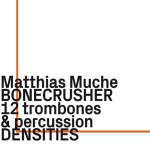
Artist: Matthias Muche’s BONECRUSHER (@)
Title: Densities - for 12 trombones & percussion
Format: Download Only (MP3 + Lossless)
Label: Hat Hut Records (@)
Rated:

Title: Densities - for 12 trombones & percussion
Format: Download Only (MP3 + Lossless)
Label: Hat Hut Records (@)
Rated:
There are twelve trombones on "Densities". This is the sort of information that ought to be stated early, partly because it is impressive, and partly because twelve trombones sound like the beginning of either a magnificent musical experiment or an exceptionally elaborate way of upsetting the neighbours.
Matthias Muche’s BONECRUSHER belongs firmly to the first category. Since its formation, the ensemble has treated the trombone less as a brass instrument in the conventional sense than as a complicated physical apparatus: a column of air, a collection of vibrating surfaces, a system of valves, slides, breath and resonance capable of producing sounds that seem to belong to several musical families at once. On "Densities", this idea has matured into something remarkably cohesive. The thirteen musicians do not merely produce a large sound. They create a body.
Muche, a Cologne-based composer and trombonist, has spent much of his career investigating precisely this territory, where instrumental technique becomes inseparable from the physical behaviour of sound. His work has earned him recognition including the WDR Jazz Prize for improvisation, but "Densities" makes little interest in credentials. The music is too busy examining the molecular structure of a trombone to worry about its résumé.
The album begins with “Butter”, and the title is almost perversely gentle considering what follows. The trombones accumulate in layers, initially suggesting a low-frequency weather system before gradually revealing the extraordinary number of events occurring inside it. Air becomes grain; tones become pressure; individual attacks dissolve into a thickened acoustic surface. The impression is not of twelve players standing next to one another but of one enormous instrument discovering that it has twelve mouths.
That distinction is crucial. Much of the fascination here comes from the way BONECRUSHER constantly shifts the listener’s perception of scale. A sound that initially seems monumental can suddenly disclose a tiny tremor inside it. A seemingly continuous drone turns out to be composed of subtly moving pitches and timbral variations. The music therefore possesses an unusual kind of depth: not the depth produced by reverberation or electronics, but one created entirely by the internal friction of acoustic material.
“Quater” pushes this principle further. Microtonal movements, abrupt articulations and overlapping gestures create a situation in which apparent disorder gradually reveals a remarkably precise organisation. The trombones seem to smear themselves across one another, yet small harmonic relationships keep emerging from the confusion. There is something almost tactile about it, as though the composition were being kneaded into shape rather than conventionally played.
This is where Muche’s compositional thinking becomes particularly compelling. The large ensemble is not used simply to amplify an idea. It changes the nature of the idea itself. Music written for one trombone can contain ambiguity, breath and physical instability; multiplied by twelve, those properties become architecture. A gesture is no longer merely a gesture. It becomes a surface, a pressure field, a mass with edges.
Matthias Müller’s “Up & Down” approaches the same problem from another direction. Its sustained harmonies and carefully controlled internal movement make the ensemble appear almost static at first, although the apparent stillness is constantly being modified. The trombones breathe into one another, generating small shifts in colour and pitch that gradually alter the whole structure. It is an excellent demonstration of how much movement can be hidden inside a sound that, from a distance, appears motionless.
Then comes Johannes Bauer’s “Brass / Breath / Brisk”, originally conceived in the late 1990s and here transformed from its solo/tape origins into an ensemble piece through the work of Jeb Bishop, Matthias Müller and Muche. The historical dimension matters. Bauer, who died in 2016, was one of the great European trombonists of free improvisation, and his presence is felt not through nostalgia but through the physical unruliness of the material. The piece has a rougher grain than the preceding works, with blocks of brass colliding, separating and reforming while Etienne Nillesen’s prepared snare provides a wonderfully economical counterweight.
Nillesen deserves particular attention because his percussion does not behave like percussion in any ordinary orchestral sense. The snare becomes another resonating object, sometimes sharply articulated, sometimes almost suspended within the brass. Its presence prevents the twelve trombones from becoming an entirely self-contained organism. It punctures the mass, gives it a skeleton, occasionally reminds us that rhythm has not been abolished, merely buried somewhere under several tonnes of brass.
And that is perhaps the central achievement of "Densities": it manages to be massive without becoming blunt.
There is plenty here that could easily have collapsed into undifferentiated heaviness. Twelve trombones offer a frighteningly efficient route towards sonic obesity. Instead, BONECRUSHER repeatedly finds cracks inside the density. Breaths, overtones, unstable pitches, tiny articulations and differences in attack remain audible. The music can be abrasive, even physically imposing, but it is rarely merely loud. Its power comes from the complexity packed inside the weight.
The title consequently works on several levels. These are densities of sound, certainly, but also densities of bodies, air, time and attention. The album asks what happens when an instrument normally associated with a single voice is multiplied until individuality begins to disappear. What remains is neither anonymity nor uniformity. It is a collective identity in which the smallest discrepancies become part of the composition.
There is something quietly philosophical about that. The ensemble does not erase the individual players; it makes their differences useful. Twelve trombones can approximate a single organism precisely because no twelve human beings will ever produce exactly the same sound. The imperfections are not defects to be corrected but the material from which the larger form emerges.
Muche's fascination with the trombone therefore reaches beyond extended technique. He is interested in what happens when an instrument is treated as a physical proposition rather than a predetermined vocabulary. The trombone is allowed to be metallic, breathy, granular, vocal, mechanical, spectral and occasionally almost orchestral. It can growl like machinery one moment and become astonishingly fragile the next.
That fragility is what saves "Densities" from becoming a mere demonstration of force. Beneath the muscular title and the intimidating personnel list there is a surprisingly delicate record, one that pays attention to the smallest variations in pressure and resonance. The brute and the microscopic coexist without cancelling one another.
Listening to it is consequently less like hearing a brass ensemble and more like standing inside a machine that has developed an unexpectedly sophisticated inner life.
Which is a fairly good reason to forgive it for having twelve trombones.
"Densities" is an imposing, meticulous and occasionally beautiful piece of contemporary acoustic music. It demonstrates how much can still be extracted from an instrument whose conventional identity seems almost too familiar to surprise us anymore. Muche and BONECRUSHER do not reinvent the trombone by disguising it. They do something more interesting: they expose the strange thing that was already hiding inside it.
The result is music of considerable physical presence, but also of patience and precision. It crushes bones only metaphorically. The ears, however, are invited to undergo a rather more elaborate treatment.
Oren Ambarchi & Will Guthrie: Cold Shoulder
Artist: Oren Ambarchi & Will Guthrie (@)
Title: Cold Shoulder
Format: LP
Label: Futura Resistenza (@)
Rated:
Title: Cold Shoulder
Format: LP
Label: Futura Resistenza (@)
Rated:
There is a particular kind of confidence that only arrives after decades of curiosity, failure, experimentation, and a healthy refusal to behave like the music industry expects. "Cold Shoulder", the new collaboration between Oren Ambarchi and Will Guthrie, feels like the work of two musicians who have finally reached the point where they no longer need to prove anything. They simply listen, react, disappear into the sound, and allow the music to become something larger than either player. A rare luxury in a world where everyone seems compelled to announce their own genius every five minutes, preferably through a social media caption written in capital letters.
The two musicians have been travelling along parallel but wonderfully irregular paths for many years. Australian guitarist and composer Oren Ambarchi has built a singular career by transforming the guitar into something almost unrecognisable: not a traditional harmonic instrument, but a laboratory of vibrations, resonances, electrical ghosts and architectural spaces. His work has moved between experimental electronics, minimalism, improvisation and the physical weight of rock, collaborating with artists as diverse as Jim O’Rourke, Keith Rowe, Keiji Haino and members of Sunn O))).
Will Guthrie, meanwhile, has always approached percussion as a universe rather than a role. A drummer in the most expanded sense of the word, he has explored the relationship between rhythm, objects, electronics and physical resonance, moving from the radical electro-acoustic investigations of his earlier years to a renewed fascination with drums, gongs and gamelan-inspired structures. His Ensemble Nist-Nah project further demonstrates his interest in percussion as a meeting point between cultures, bodies and collective memory.
On "Cold Shoulder", recorded live in Berlin in late 2024, the history between the two artists becomes almost audible. This is not a meeting of strangers searching awkwardly for a common language. It is a conversation between old friends who already know when silence is more important than sound. The album consists of two lengthy pieces, each occupying one side of the vinyl, and this format feels almost inevitable: these are not compositions that demand attention through dramatic gestures, but slow-moving ecosystems where every small change becomes meaningful.
The opening moments reveal Ambarchi’s guitar transformed into a drifting, organ-like presence. His familiar use of Leslie effects creates a sensation of circular movement, as if the sound itself were slowly rotating in a vast empty room. Yet the apparent calm is deceptive. Beneath the surface, tiny shifts constantly reshape the landscape. A harmonic shadow appears, a tone stretches into infinity, a vibration begins to suggest melody before dissolving again. Ambarchi has always been fascinated by the border between recognisable music and pure physical sensation, and here he finds one of his most elegant balances between the two.
Guthrie’s contribution is equally fascinating because of what he chooses not to do. This is not percussion as punctuation, nor rhythm as an obvious driving force. His playing operates like weather: sometimes barely visible, sometimes suddenly revealing the enormous amount of movement hidden inside apparent stillness. Cymbals shimmer like distant metallic reflections, subtle pulses emerge and vanish, and the drums become less a rhythmic machine than a living surface responding to the vibrations around them.
The magic of "Cold Shoulder" lies precisely in this tension between stability and uncertainty. The music feels peaceful, but never passive. It floats, yet never loses direction. Like watching clouds slowly rearrange themselves, it creates the illusion of simplicity while hiding an extraordinary amount of control. Humans have spent centuries inventing increasingly complicated tools to make things easier, then created experimental music to remind themselves that complexity was there all along. A wonderfully inefficient species, really.
The album also represents something important in the wider story of improvisational music: maturity not as reduction, but as freedom. The younger versions of Ambarchi and Guthrie explored extremes, fragmentation, noise and abstraction. Those experiences remain present, but they no longer need to dominate the conversation. The violence has become texture; the chaos has learned patience.
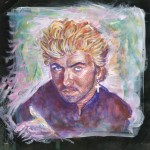
There is also a playful side to the release, symbolised by the wonderfully unexpected cover image featuring George Michael. It is a reminder that experimental music does not have to exist behind a wall of seriousness and academic gloom. Sometimes the most radical gesture is simply allowing beauty, humour and contradiction to coexist. The universe is strange enough already, so perhaps a drone record with a pop icon watching over it is actually the most logical artistic statement possible.
"Cold Shoulder" is therefore not a record about distance despite its title. It is about intimacy achieved through space, about two musicians comfortable enough with each other to leave room for uncertainty. It is music that does not chase the listener but quietly changes the atmosphere around them. A slow-burning conversation between electricity, skin, metal and memory.
After twenty years of collaboration, Ambarchi and Guthrie have produced something that feels neither like a retrospective nor a conclusion. It feels like a continuation, a reminder that experience does not necessarily make artists predictable. Sometimes it simply gives them the confidence to wander further.
And fortunately, they still know how to get wonderfully lost.
Dionée: Mille-feuilles
There are records that politely ask for your attention. Others kick the door open with volume. Dionée's "Mille-feuilles" does neither. It simply occupies the room until you begin hearing differently. That may sound suspiciously mystical, but the trio's music has little interest in transcendence for its own sake. Instead, it patiently constructs a landscape where unlikely materials coexist with startling naturalness: chamber music elegance brushing against the grain of drone, post-rock weight appearing without guitars, electroacoustic abstraction refusing to become mere academic exercise. It is, as the press release jokingly suggests, somewhere between Black Sabbath and Morton Feldman. Ridiculous on paper. Surprisingly convincing in practice.
Dionée is the latest project led by Québec composer and bassist Éric Normand, a prolific figure in Canada's experimental music community whose career has moved effortlessly between free improvisation, composition, and large ensemble work. His collaborations with improvisers such as Xavier Charles, Franz Hautzinger, and Anne-F Jacques have established him as an artist who thrives on instability, constantly seeking new relationships between sound sources rather than fixed stylistic identities. With Clarisse Bériault and Robin Servant, however, the objective feels different. Rather than celebrating improvisational friction, the trio pursues cohesion without sacrificing unpredictability.
The instrumentation alone deserves a raised eyebrow. Oboe, diatonic accordion, electric bass, oscillators, effects, beatboxing and electronics should, by all reasonable expectations, compete for attention. Instead they dissolve into what frequently resembles a chamber orchestra viewed through frosted glass. Individual instruments lose their sharp outlines, merging into slow-moving masses where acoustic resonance and electronic coloration become almost impossible to separate. One spends less time identifying who plays what than wondering how such familiar sounds became so strangely anonymous.
Normand's compositional approach favours gradual transformation over dramatic contrast. The two extended pieces unfold like evolving ecosystems rather than conventional compositions with clearly marked destinations. Themes emerge almost accidentally before being swallowed by sustained drones, harmonic shadows or subtle rhythmic currents. There is movement everywhere, yet very little appears hurried. The music trusts the listener's patience, a quality becoming increasingly rare in an era where albums often seem terrified of silence.
Bériault's oboe plays an especially fascinating role. Traditionally associated with pastoral lyricism or orchestral melancholy, it becomes something far less predictable here. Sometimes it cuts through the dense textures with almost vocal fragility; elsewhere it functions as another layer within the harmonic fog, its identity deliberately obscured by electronics and processing. Servant's accordion undergoes a similar transformation. Any expectation of folk nostalgia is quickly dismantled as its reeds become sources of sustained harmonic pressure rather than melodic comfort.
The album's title, "Mille-feuilles", inevitably evokes layers, and layering is indeed central to the listening experience. Yet these are not neatly stacked architectural strata. They resemble geological deposits compressed over centuries, where traces of different musical histories remain visible without ever separating cleanly. Minimalism rubs shoulders with doom-like harmonic gravity, contemporary classical restraint brushes against noise aesthetics, and occasional melodic fragments appear like half-remembered conversations overheard through thick walls.
One of the album's quiet achievements lies in how it handles density. Many experimental records equate complexity with saturation, filling every available frequency until subtlety suffocates. Dionée exercises remarkable restraint. Even at its heaviest, the music breathes. Empty spaces are not absences but active participants, allowing resonance to linger long enough for the ear to discover secondary events hidden beneath the obvious ones. It rewards repeated listening not because it is deliberately obscure, but because its internal relationships remain fluid.
There is also an understated cinematic quality throughout, though thankfully one that avoids becoming "soundtrack music" in the fashionable sense. Rather than illustrating imaginary scenes, these compositions generate psychological environments. They suggest abandoned industrial halls, dense northern forests, forgotten religious architecture, or perhaps none of these at all. The images remain personal, shaped as much by the listener's memory as by the musicians' intentions.
The two lengthy tracks refuse convenient climaxes. Instead they accumulate emotional weight through persistence, allowing microscopic shifts in timbre or harmony to feel monumental. This approach demands concentration, but it also offers something increasingly uncommon: the satisfaction of inhabiting a musical space instead of merely consuming it.
If there is humour here, it comes from the trio's quiet defiance of categorisation. Calling this chamber music feels incomplete. Calling it drone undersells its melodic intelligence. Labeling it post-rock ignores its compositional sophistication. Experimental music has always enjoyed inventing increasingly specialised boxes; "Mille-feuilles" politely stacks those boxes into a bonfire and continues playing.
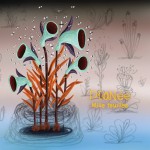
Beautifully recorded and enhanced by Marnix Everaert's striking visual presentation, the album confirms that adventurous music need not choose between intellectual curiosity and emotional resonance. Dionée builds bridges where others erect boundaries, demonstrating that the distance between Feldman's stillness and Sabbath's physicality may not be as vast as genre maps would have us believe. Sometimes all it takes is three musicians willing to ignore the signposts and trust that listeners are capable of getting pleasantly lost.
Justina Repečkaitė: Tapestries
Artist: Justina Repečkaitė (@)
Title: Tapestries
Format: CD
Label: Music Information Centre Lithuania (@)
Rated:
Title: Tapestries
Format: CD
Label: Music Information Centre Lithuania (@)
Rated:
There are composers who write music as if they were building monuments, and others who compose as if they were patiently weaving threads. Lithuanian composer Justina Repeckaite undoubtedly belongs to the latter category. Her debut portrait album, "Tapestries", gathers works spanning more than a decade, from 2012 to 2024, but this is far more than a retrospective. It feels like wandering through a carefully curated exhibition where each room reveals another facet of an artistic language shaped equally by architecture, medieval symbolism, acoustics, and an unusually tactile understanding of sound.
Now based in Paris after studies in Lithuania, France, and at the renowned IRCAM, Repeckaite has quietly become one of the Baltic region's most compelling contemporary voices. Her catalogue reveals an obsession with materiality: sounds are rarely treated as abstract entities but as textures that can be folded, embroidered, layered or carved, much like the textile metaphors that recur throughout her work. Architecture, illuminated manuscripts, stained glass and ancient craftsmanship are not decorative references but structural models that influence the music's internal logic.
The album opens with "Chartres", inspired by the famous cathedral's South Rose Window. One could easily fear an exercise in programmatic illustration, but Repeckaite avoids picturesque gestures altogether. Instead, overlapping orchestral layers gradually assemble into something resembling light passing through coloured glass. Rather than depicting the cathedral, she captures the experience of standing inside it, where geometry quietly transforms into emotion.
Throughout the programme, her fascination with the human voice emerges repeatedly, often in unexpected ways. "Incantare" asks the flautist to sing while playing, creating unstable timbral collisions between breath, melody and whispered incantations. Built entirely from recordings of the composer's own voice, the electronic layer never feels artificial. It breathes, rustles and hovers like an invisible chorus somewhere between folklore and psychoacoustics. One begins listening for melodies, only to discover that breathing itself has become the melody.
"Tapisserie", arguably her signature work, embodies her compositional philosophy most clearly. Individual instrumental attacks are interwoven until they lose their separate identities, becoming a single living fabric whose colours constantly shift without ever unraveling. The process resembles watching an artisan at work from so close that the final image disappears, replaced by the hypnotic rhythm of the weaving itself.
Repeckaite frequently draws inspiration from historical sources without becoming nostalgic. "La Cité des Dames", based on Christine de Pizan's fifteenth-century proto-feminist text, transforms six soprano lines into a luminous polyphonic architecture. Particularly remarkable is Kanae Mizobuchi's performance, patiently layering every vocal part herself until the composition becomes an intimate conversation between multiple versions of the same voice. It is simultaneously fragile and monumental, like discovering that a cathedral has been built entirely from whispers.
Elsewhere, "Sturnus vulgaris cohibitus" transforms lockdown observations of starlings into an unpredictable dialogue between piano and electronically animated birdsong. The concept could easily have collapsed into novelty, but instead becomes an elegant meditation on coexistence, where the pianist seems less interested in controlling nature than negotiating with it. The birds, predictably, refuse to behave according to the score. One suspects they never signed the recording contract.
The orchestral "Vellum" demonstrates Repeckaite's growing confidence with large forces, building its harmonic language from the resonant behaviour of percussion membranes while drawing poetic parallels between parchment and skin, manuscript and vibration. Even when the orchestra reaches moments of considerable intensity, the music never loses its extraordinary sense of precision. Every gesture feels inevitable rather than merely dramatic.
The album concludes with "La muë", perhaps the collection's most ambitious work, combining serpent, children's choir and electronics in a meditation on vocal transformation inspired by an eighteenth-century scientific treatise. Here Repeckaite once again demonstrates her remarkable ability to merge historical materials with cutting-edge technology without allowing either to dominate. Ancient instruments, spatial audio processing and human voices become parts of the same evolving organism.
What makes "Tapestries" particularly rewarding is its refusal to separate intellectual ambition from sensory pleasure. Contemporary composition sometimes risks becoming either academically opaque or emotionally simplistic. Repeckaite occupies a far more interesting middle ground. Her music is meticulously constructed, yet never feels imprisoned by its own concepts. Beneath the architectural proportions, mathematical relationships and elaborate timbral research lies an unmistakable curiosity about how humans actually listen.
Perhaps that explains why the album succeeds so completely as a portrait. Like an intricately woven textile, its beauty is visible from afar, but its real fascination emerges only when leaning closer, discovering that every thread carries its own story while remaining inseparable from the whole. In an era obsessed with immediate impact, "Tapestries" quietly reminds us that some of the most enduring works reveal themselves stitch by stitch.
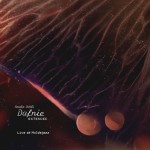
Amalie Dahl: Dafnie EXTENDED - Live at Moldejazz
Artist: Amalie Dahl (@)
Title: Dafnie EXTENDED - Live at Moldejazz
Format: LP
Label: Sonic Transmissions Records (@)
Rated:

Title: Dafnie EXTENDED - Live at Moldejazz
Format: LP
Label: Sonic Transmissions Records (@)
Rated:
There is a peculiar moment that every composer secretly hopes for and simultaneously fears: the instant when a carefully cultivated musical language outgrows its original frame. Some projects become diluted when expanded, like adding too much water to good coffee. Others reveal dimensions that were always hiding beneath the surface. "Dafnie EXTENDED: Live at Moldejazz" belongs emphatically to the latter category.
Danish-born, Oslo-based saxophonist and composer Amalie Dahl has rapidly become one of the most compelling figures in the flourishing Scandinavian jazz scene. After studying at NTNU in Trondheim, she steadily built a reputation through projects such as "Breaking/Building Habits", collaborations with Ingebrigt Håker Flaten and several adventurous ensembles, while her quintet Dafnie established itself as a vehicle where rigorous composition and fearless improvisation coexist without either one bullying the other. Rather than treating free jazz as an excuse for chaos or composition as an exercise in control, Dahl has consistently sought the unstable territory where both impulses strengthen one another.
This live recording documents the world premiere of the expanded twelve-piece version of Dafnie at Moldejazz in 2025, and the enlargement feels entirely organic. The original quintet has not simply recruited reinforcements; it has evolved into something resembling a living ecosystem. The additional brass, electronics, accordion, piano, second double bass and second drummer create an ensemble capable of changing its density almost instantaneously, moving from whispering chamber music to orchestral turbulence with astonishing agility.
The opening "Intro" serves less as a traditional introduction than as the slow lifting of a curtain. Textures emerge cautiously, as if each musician is testing the acoustics of the room before committing to the collective narrative. Dahl's writing often begins with deceptively modest melodic fragments, allowing repetition and subtle variation to generate momentum rather than relying on obvious thematic statements. It is an approach that recalls aspects of minimalist thinking without ever becoming mechanically repetitive.
As the performance unfolds through "Floating" and "Drifting_Turning", the ensemble demonstrates remarkable discipline. Large jazz orchestras often resemble committees attempting spontaneous conversation, admirable in theory, occasionally exhausting in practice. Here, however, every voice retains its individuality while contributing to an unmistakably unified sound. Oscar Andreas Haug's trumpet, Henriette Eilertsen's flute and electronics, Sofia Salvo's baritone saxophone, Lisa Ullén's piano and Anna Ueland's synthesizer continuously reshape the harmonic landscape without cluttering it.
Perhaps the most striking achievement lies in the rhythm section. Having two double bassists, Nicolas Leirtrø and Ingebrigt Håker Flaten, alongside two drummers, Trym Karlsen and Veslemøy Narvesen, could easily produce excessive density. Instead, the quartet functions almost architecturally, constructing shifting foundations that allow the horns extraordinary freedom. Rather than merely keeping time, they generate landscapes upon which the music continually rebuilds itself.
"Parallels" beautifully illustrates Dahl's compositional philosophy. Melodic cells circulate among the musicians like shared thoughts, gradually accumulating emotional weight without ever settling into predictable resolutions. Solos emerge naturally from the ensemble rather than interrupting it, reinforcing the impression that individuality here exists only through dialogue. It is collective improvisation understood not as simultaneous freedom but as mutual responsibility.
The emotional center of the album may arrive with "Slow Motion". Its spacious pacing allows silence to become almost as expressive as sound. Every sustained note seems to carry the memory of the previous phrase while anticipating the next. There is remarkable confidence in allowing music to breathe. In an era where many recordings appear terrified of empty space, Dahl demonstrates that restraint often carries greater dramatic force than perpetual activity.
When "In Flux" finally erupts into dense, energetic passages, the release feels entirely earned. Free jazz energy is abundant here, but never gratuitous. The ensemble doesn't explode because improvisers are contractually obliged to reach maximum volume at some point. It expands because the internal logic of the composition demands it. That distinction makes all the difference.
The concluding "Longing" offers an appropriately reflective ending. Rather than delivering a triumphant finale, Dahl allows the music to gradually dissolve into openness, suggesting that the performance represents one moment within a much longer ongoing conversation. It is an ending that resists closure, inviting repeated listening instead of providing definitive answers.
The live recording itself deserves special mention. Capturing a twelve-piece ensemble without sacrificing clarity is no small accomplishment, and the production preserves both the physical impact of the larger passages and the intimacy of quieter interactions. One can almost visualize musicians listening as intensely as they play, a quality that separates genuine ensemble music from carefully organized simultaneity.
What makes "Dafnie EXTENDED" particularly rewarding is that it refuses to treat scale as spectacle. Bigger does not mean louder, busier or more virtuosic for its own sake. Instead, Dahl uses the expanded instrumentation to deepen her exploration of texture, movement and collective expression. The orchestra becomes less a monument than a breathing organism, constantly adapting while preserving its identity.
There is also something quietly optimistic about this music. At a time when so much contemporary culture celebrates individual brilliance, Dahl places her faith in collaboration. Every musician contributes a distinct personality, yet none dominates the narrative. The result suggests that complexity need not produce confusion and that freedom can flourish precisely because structure exists.
"Dafnie EXTENDED: Live at Moldejazz" confirms Amalie Dahl as one of Europe's most imaginative composers working at the intersection of contemporary jazz and large ensemble improvisation. More importantly, it demonstrates that ambitious musical ideas do not require grandiosity to make their impact. Sometimes twelve musicians can sound less like an orchestra than like a single mind dreaming collectively, discovering, note by note, that expansion is not about occupying more space, but about listening more deeply to the space already there.